I have a fairly ambitious opinion about the future of 3D modeling. To explain it, I have dressed a cat in samurai armor.
The cat has no opinion on file formats. I do.
I think real AI CAD will replace mesh-only generation as the default way people turn an idea into a model they intend to keep working on. A convincing shape will no longer be enough. People will expect a model they can understand, change, and develop without starting over.
That is a prediction about the modeling workflow, not a claim that every polygon used in graphics will disappear. Meshes can still be useful for display, exchange, and other downstream tasks. What I want to replace is the point where “here is your mesh” means the design process has effectively ended.
This samurai cat is one example of the direction I'm building toward with Nora3D.
From a reference image to a CAD model
The video opens with a reference image: a black-and-white cat with amber eyes, dark armor with gold trim, and a pink waist bow. It is a character, not a bracket or a mounting plate.
That matters. I don't want AI CAD to be interesting only when the object happens to look like a collection of mechanical parts.
In the recorded conversation, Nora3D asks for the figure's overall height and permission to estimate depth and rear details from a single front image. I specify 20 cm. That is the requested size, not a measurement report of the finished model.
The model then takes shape in stages. The head, torso, and limbs establish the proportions. Ears, eyes, and muzzle make it recognizably a cat. Armor panels, gold borders, and the pink belt establish the character. Whiskers and small armor details arrive later.
The result is a stylized interpretation of the reference, not an exact reconstruction of every surface. A front image cannot tell us precisely what the back looks like. In this workflow, that ambiguity becomes a modeling decision rather than a hidden promise of accuracy.
The edit also shows pauses and follow-up messages such as “ok” and “go on.” This is an iterative modeling session, not evidence of a flawless one-click operation or a generation-speed benchmark.
Why a character is a useful test
An armored cat brings together rounded forms, thin details, angular panels, and distinct colors. It asks a CAD workflow to do something more expressive than another block with four holes.
What interests me is watching those elements accumulate in the modeling workspace. The armor appears around a body that already exists. The facial details give personality to a head whose basic shape is already there. The model develops through construction, not just a final reveal.
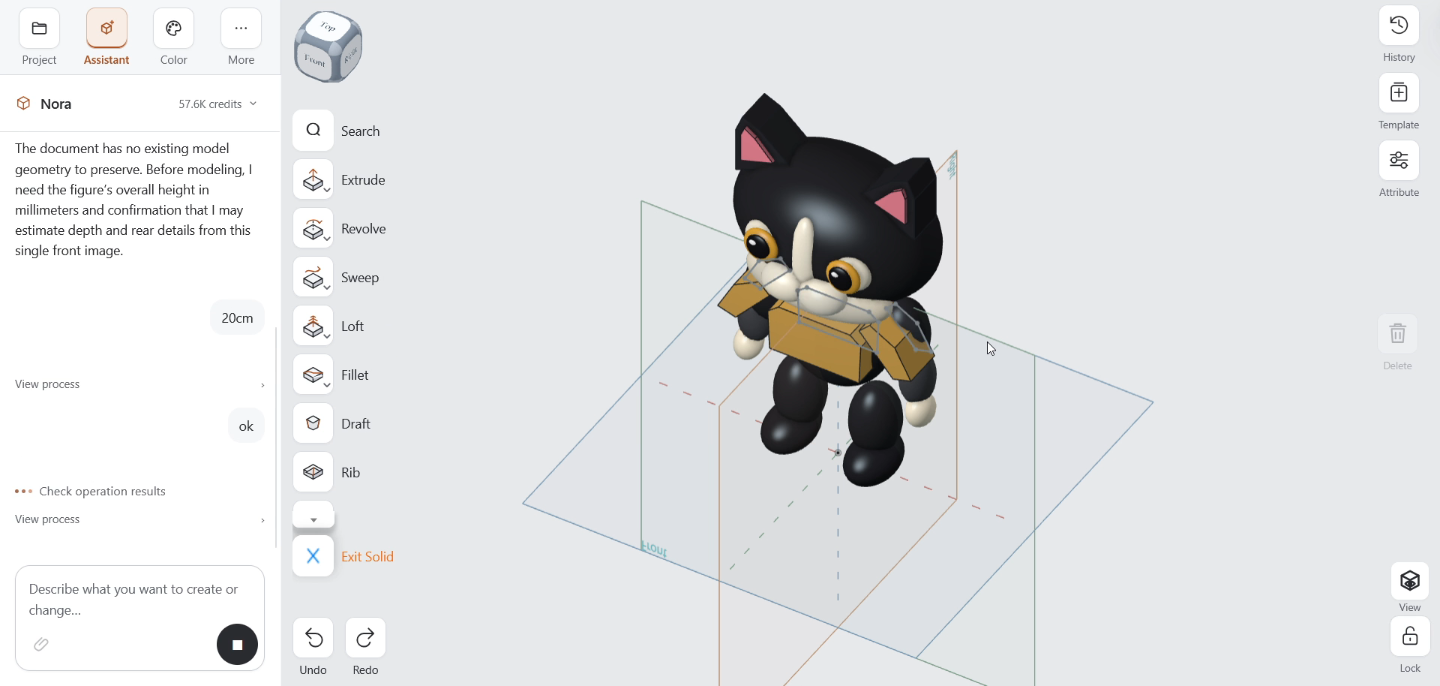
A screenshot alone cannot tell you how useful a model will be tomorrow. For me, the important question is what happens when the design changes.
Suppose I want a wider stance, a different belt, or thicker whiskers before making a physical version. Those are the next questions I would test, not edits demonstrated in this clip. The kind of AI CAD I want to build should make such changes part of the same modeling process, with predictable effects on the geometry.
Mesh editing is real but it is a different starting point
I am not arguing that meshes cannot be edited. They can. Nor does a smooth-looking object prove that it is a good CAD model.
The distinction is the representation and the design information available to the next operation. A polygon mesh describes a surface through vertices, edges, and faces. CAD solid and surface modeling can work with geometric surfaces, their boundaries, and modeling features. A feature history or meaningful parameters add another layer of information; they do not magically appear just because a file has been labeled CAD.
Conversion is possible too. Autodesk's Fusion documentation describes faceted, prismatic, and organic mesh conversion methods. Faceted conversion maps individual mesh faces to faces on the resulting body, while other methods infer or fit geometry. Converting a representation is not the same as recovering the designer's original intent.
My bet is that people will increasingly prefer AI that builds useful modeling structure in the first place, instead of leaving them to recover it afterward.
What I mean by real AI CAD
For me, real AI CAD is an AI system participating in the design process, not merely delivering an attractive shape. It should ask about dimensions, make its assumptions visible, build geometry that supports further work, and let the person keep control of the result.
The samurai cat illustrates part of that ambition: an image becomes a staged CAD modeling process, including a size request, follow-up interaction, and a progressively more detailed character. It does not establish that every later edit will succeed, that the model is ready to manufacture, or that CAD has already surpassed mesh workflows in every field.
The broader prediction is still mine: as AI CAD becomes more capable, a mesh-only endpoint will feel increasingly limiting for people who want to design rather than simply receive a shape. The model should be the beginning of the next decision, not the end of the conversation.
That is why I'm building Nora3D.
Today's example happens to be a samurai cat. The serious part is what we should expect to be able to do with it next.
Try Nora3D or watch another example of continuing a design after AI generation.